


Product Overview
Automatic Dual Stacker for Roll Forming Production Lines
The Automatic Dual Stacker is designed as a downstream stacking solution for roll forming production lines. It is used to automatically receive, stack, and organize finished metal sheets after forming, ensuring stable output, consistent stacking quality, and continuous production flow.
This system is widely applied in roll forming machine factories, metal roofing and wall panel manufacturing plants, and integrated roll forming lines where automation, efficiency, and operational stability are required.
Working Principle of Automatic Dual Stacker
The automatic dual stacker is installed at the end of the roll forming machine or cutting system. Finished metal sheets are transferred from the run-out table to the stacking unit, where the stacker automatically positions, counts, and stacks the sheets according to preset parameters.
The dual stacking design allows continuous operation by alternating stacking positions, ensuring smooth production without interruption during stacking cycles.
Products Description
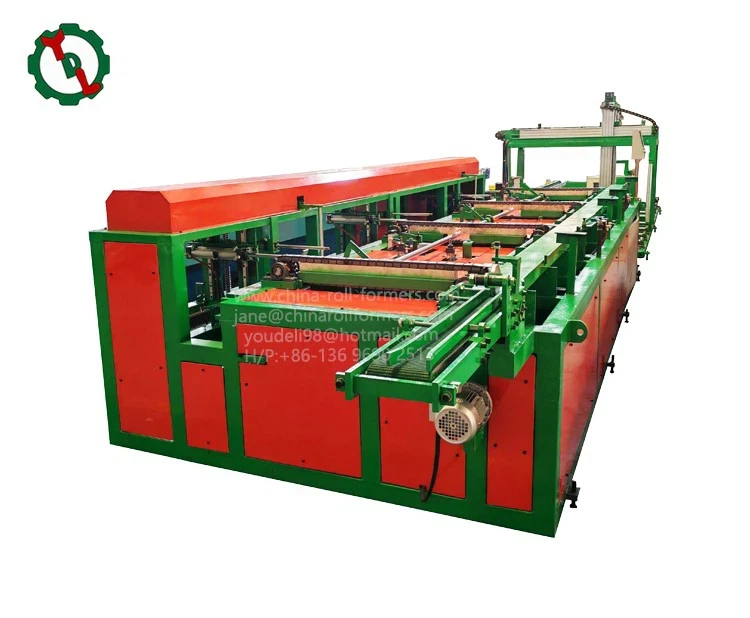


Automated Stacking Solutions for Modern Roll-Formed Metal Products
In the roll-forming manufacturing industry, the post-production handling and stacking of products are often critical factors impacting overall production efficiency and product quality. Traditional manual handling and stacking methods are not only labor-intensive and pose safety risks, but also struggle to ensure neat and stable stacks, frequently leading to surface scratches or deformation of the sheets. To address this challenge, the automatic dual-station stacking system has emerged as essential equipment for enhancing the intelligence level of production lines.
Designed specifically to handle diverse, high-volume outputs of roll-formed products, the system's core strengths lie in its exceptional applicability and flexibility. It can efficiently and accurately process various common types of roll-formed products:
Roofing and Wall Panels: Including color-coated steel roofing sheets and metal wall panels widely used in various constructions. The system ensures their coated surfaces remain undamaged during the stacking process.
Special Profiles: For trapezoidal sheets requiring high structural strength and standing seam panels with stringent installation precision demands, the system achieves stable and aligned stacking.
Long-Length Profiles: It can also reliably collect and organize longer roll-formed special-shaped sections, meeting the production needs of non-standard products.
The integration approach of the automatic dual-station stacking system highlights its high degree of adaptability. For companies planning new production lines, it can be incorporated as part of a complete automation solution from the initial design phase, seamlessly integrating into the line layout to achieve smooth, uninterrupted operation from forming and cut-to-length shearing to stacked finished products. For the many manufacturers with established production lines, this system represents an ideal choice for automation retrofitting and upgrades. It can be effectively interfaced with existing equipment such as roll formers and shears, significantly enhancing the automation level of downstream processes without requiring large-scale modifications to the main line. This allows companies to achieve a leap in capacity and quality with a reasonable investment.
In practical application, the system automatically performs product receiving, transfer, layering, and stacking through precise servo control and sensing technology. The dual-station design enables automatic switching to an empty pallet when one is full, allowing for uninterrupted continuous production. This not only substantially reduces the operational burden on workers but also ensures every stack is uniform and neat through programmed precision operations, facilitating subsequent packaging, storage, and transportation.
In summary, the automatic dual-station stacking system is more than just simple material handling equipment; it is a key component for roll-forming production lines to achieve higher quality, increased efficiency, and reduced costs. By employing mature automation technology, it effectively solves the challenge of high-standard stacking for diverse workpieces. Whether for a brand-new layout or an upgrade of an existing line, it delivers immediate benefits for enterprises, helping them build a solid foundation for smart manufacturing in a competitive market.
Technical Parameter

Daily maintenance:
Clean: Regularly clean the surface of the equipment, including the operation panel and electric control cabinet, to ensure that there is no dust and debris. At the same time, clean up the debris in the track of the ground vehicle and the measurement and positioning track to keep it unblocked.
Lubrication: According to the requirements of the equipment manufacturer, the parts that need to be lubricated are regularly lubricated, such as bearings, slides, horizontal guide wheels, drive wheels, etc. Use appropriate lubricant to ensure smooth operation of all components.
Check:
Check that the electrical connection is strong, the cable is not damaged, and the control panel and switch are working properly.
Check that sensors and safety devices are sensitive and accurate, such as infrared sensors, limit switches, etc.
Check mechanical structures, such as lifting devices, fork extenders, walking devices, etc., to ensure that fasteners and connecting parts are not loose, worn or deformed.
Regular maintenance:
Replace wearing parts: Replace brake pads, hydraulic oil, filters and other wearing parts regularly to ensure stable equipment performance.
Adjustment: Adjust the equipment, such as the horizontal guide wheel, lifting guide wheel, etc., to ensure that the gap between it and the track meets the requirements, and maintain the stability of the equipment operation.
In-depth inspection: Carry out in-depth inspection of the electrical system and mechanical structure of the equipment to find potential problems and deal with them in time to prevent the expansion of faults.
Technical support and training:
Technical support: When encountering complex problems, contact the equipment manufacturer or professional maintenance personnel for technical support and troubleshooting.
Training: Regular technical training for operation and maintenance personnel to improve their skills and knowledge to ensure that equipment is properly operated and maintained.
Note:
When performing maintenance, be sure to follow the operation and maintenance manual provided by the equipment manufacturer to ensure correct and safe operation.
For non-professionals, do not disassemble or repair the equipment without authorization, so as to avoid damage or safety risks.
Sample Chamber

After-sales service commitment:
The business views the client as the focal point and works to ensure that you have worry-free installation, commissioning, training, maintenance, and other after-sales care.
Pre-sales service: prior to a contract being signed, the company offers technical consulting services for equipment, assisting clients in choosing the right type and other services; upon signing, we promise to fulfill the requirements of the client, be prepared to finish the contract, and stay in contact at any time to update them on the status of production;
2. Installation services: As per the agreement, the business will send out qualified technicians to install the equipment in one to five days after it is delivered to the production site. They will also provide on-site technical operation advice until the operator is able to use the equipment regularly.
Maintenance of the equipment: the company guarantees that, starting from the date of purchase, the equipment will have a free one-year warranty and lifetime maintenance. Whether or not the equipment is still covered by warranty, the company will provide prompt maintenance services, and after learning about the customer's maintenance requirements, after-sales service staff will get in touch with you right away.
Cargo Loading


Hot Tags: Automatic Dual Stacker, China, manufacturers, suppliers, factory, customized, good quality, good service, for design, for sale, made in china, snap lock metal roofing machine, YOUDELI standing roofing machines, roof seamer Factory, roof seamer machine, used standing seam roll former, roof seamer


